When Everything Is Urgent, Nothing Is
It's 8:05 Monday morning, and the maintenance requests are already rolling in.
Someone's office is too cold. There's a dripping faucet in the second-floor bathroom. The HVAC system serving an entire wing has stopped working. And a light is out in the meeting room just before an important presentation.
Naturally, all four requests are marked urgent. By 8:45, someone's already calling to ask why their work order hasn't been completed yet.
Welcome to facility maintenance, where everything is an emergency and your carefully planned schedule is more of a suggestion to others.
The problem isn't necessarily how many requests come in. It's deciding what deserves attention first when everyone thinks their problem is the most important one. And when every work order is a high priority, nothing really is.
Why Every Maintenance Work Order Can't Be a Priority
To be fair, most people aren't trying to make the maintenance team's day difficult. They have a problem, and they want it fixed. But when you're managing maintenance for an entire building, you can't treat every request the same way. A dripping faucet isn't the same as a burst pipe flooding the second floor, and an office that's a little too cool isn't nearly as serious as an HVAC system going down in a hospital.
The trouble starts when there's no clear way to decide what comes first. Suddenly, the person who calls three times, complains the loudest or catches a technician in the hallway gets bumped to the top of the list. Meanwhile, the work that actually needs attention gets pushed back, and just like that, your maintenance schedule goes out the window.
What Are the Four Maintenance Work Order Priority Levels?
So how do you decide what gets fixed first? Most maintenance teams can start with four priority levels: critical, high, medium and low. Nothing complicated, just a way to separate genuine emergencies from the jobs that can wait.
The important part is making sure everyone understands what those levels mean. If someone thinks critical means "I'd like this done before lunch," you're right back where you started.
Maintenance Work Order Priority Matrix
| Priority | What It Means | Example | Suggested Response |
|---|---|---|---|
| P1: Critical | Immediate safety threat or major operational risk | Gas leak, exposed live wiring, blocked emergency exit | Immediate emergency response |
| P2: High | Serious disruption or risk of more damage | Active water leak, failed HVAC serving important occupied areas | Same day |
| P3: Medium | Repair needed, but things can keep running safely | Dripping faucet without damage, noncritical equipment problem | Within several days |
| P4: Low | Minor or cosmetic work | Touch-up painting, replacing a nonessential fixture | Scheduled maintenance window |
These are example response times. Each facility should set its own priorities based on safety requirements, the type of building and the people using it. Emergency situations should follow established emergency procedures.
Of course, what counts as urgent can change depending on where you work. A broken refrigerator in an office lunchroom is annoying, but a broken refrigerator storing temperature-sensitive medication is a much bigger problem. Same equipment, very different consequences.
That's why priority levels need to make sense for your facility. What can wait a few days in one building might need attention right away in another.
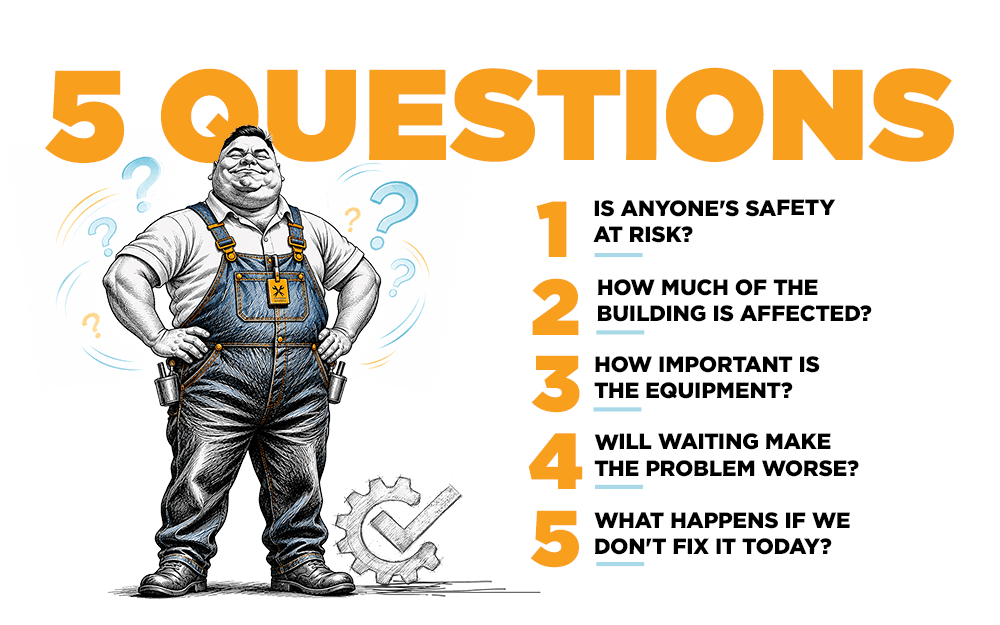
Five Questions to Ask Before Moving a Work Order to the Top
A priority chart helps, but not every problem fits neatly into a category. Sometimes you need to take a closer look before rearranging everyone's day, and a few simple questions can make that decision a whole lot easier.
1. Is Anyone's Safety at Risk?
Safety always comes first, but not every maintenance problem is a safety issue. A dripping faucet or a broken cabinet door might be annoying, but neither is likely to put someone in danger. A water leak near electrical equipment or a damaged stairway, on the other hand, is a different story.
When someone's safety is at risk, that work order needs to move to the top of the list. Some problems can wait until tomorrow, but anything that could cause an injury needs to be dealt with right away, following the proper safety procedures.
2. How Much of the Building Is Affected?
One uncomfortable office is frustrating, but an entire school wing without heat in January is a different story. When deciding what comes first, think about how many people are affected and whether the problem is preventing part of the building from operating normally.
A problem affecting dozens of people or shutting down an important service will usually need attention sooner than something affecting one room. Even if the person in that one room has already called three times.
3. How Important Is the Equipment?
Every facility has equipment it can manage without for a little while and equipment that absolutely needs to keep running. The coffee machine in the staff lounge might feel pretty important on Monday morning, but it's probably not in the same category as an emergency generator or the equipment keeping a building's heating system running.
Knowing which equipment is essential makes it easier to decide where technicians should spend their time. It also helps prevent less important repairs from taking attention away from equipment that could cause much bigger problems if it fails.
4. Will Waiting Make the Problem Worse?
A small leak might be manageable today, but leave it long enough and you could be replacing drywall, flooring or damaged equipment. The same goes for overheating motors, strange vibrations and equipment that's showing signs of trouble.
Not every small problem turns into an expensive repair, but some have a way of getting worse at the worst possible time. Sometimes that little job you've been putting off becomes the reason everyone's working late on Friday.
5. What Happens If We Don't Fix It Today?
Sometimes the easiest way to decide what comes first is to ask what happens if the repair waits. Could someone get hurt? Will equipment fail? Could the building suffer damage or operations come to a stop? Or is it something that can wait a few days without causing any real problems?
You can't fix everything at once, especially when the work orders keep piling up. What matters is knowing which jobs need attention right away and which ones can wait without causing bigger problems.
Why Preventive Maintenance Work Orders Matter
Here's something that tends to get overlooked when every maintenance request is treated like an emergency: the work that prevents things from breaking in the first place.
Imagine a technician is scheduled to inspect a rooftop HVAC unit. It's running fine, but it's due for preventive maintenance. Before the inspection starts, three urgent requests come in. One office is too warm, someone needs a door adjusted and a meeting room light has stopped working.
The technician gets pulled away, and the inspection is postponed. Next week, the same thing happens. Eventually, that rooftop unit breaks down, and suddenly there's a real emergency on the schedule.
Funny how that works.
The problem with constantly chasing urgent requests is that planned maintenance keeps getting pushed aside. When equipment seems to be running fine, nobody worries too much about a missed inspection. At least not until something breaks down.
The goal isn't to ignore smaller requests. It's to make sure they don't keep pushing important work off the schedule. Otherwise, maintenance teams can spend so much time dealing with today's problems that they never get around to preventing tomorrow's.
How to Stop Everything From Becoming High Priority
Having four priority levels is a good start, but they won't help much if everyone keeps choosing the highest one. People need to understand what each level means, what counts as an emergency and what can wait a few days. A few real-world examples can help everyone get on the same page.
The person submitting a work order knows what's happening, but they don't always know what else the maintenance team is dealing with. That's why it's better to have the maintenance manager decide where each request belongs on the priority list. Otherwise, everyone's problem ends up at the top.
Communication helps, too. When someone submits a work order and hears nothing back, they're probably going to follow up. Letting them know their request was received and when they can expect someone to look at it can save a lot of unnecessary phone calls. It also reassures them that their request hasn't disappeared into a black hole. A CMMS can help with that by sending updates when a work order is submitted or its status changes, depending on how notifications are set up.
Priorities can change, of course. A small leak can get worse, equipment can break down or a room might suddenly be needed sooner than expected. It's worth checking outstanding work orders regularly because what seemed like a low-priority repair on Monday might be a much bigger problem by Friday.
And if you've got 47 high-priority work orders sitting in the system, either something has gone seriously wrong or your definition of high priority needs another look. Possibly both.
How to Keep Work Orders Organized
Things get even more complicated when maintenance requests are scattered across emails, spreadsheets, handwritten notes and phone calls. It's hard to decide what needs attention when there's no single place to see everything that's waiting.
That's where a CMMS can make life easier. With MaintenanceCare's work order management software, teams can create work orders, set priorities, assign technicians and keep track of what's being worked on, all in one place.
Managers can see what's waiting, what's in progress and which jobs need attention without chasing down updates. Having the work order history available also makes it easier to spot equipment that keeps causing trouble or repairs that have been pushed back a little too often.
Of course, the software isn't going to tell you that a leaking pipe matters more than a meeting room light. That's still your call. But having everything organized makes it a lot easier to see the bigger picture and keep everyone on the same page.
Not Everything Needs to Be Fixed by Lunch
There will always be someone who thinks their maintenance request should be at the top of the list, and sometimes they're absolutely right. But keeping a facility running means knowing the difference between what's inconvenient, what's important and what's a genuine emergency.
When your team has a clear way to set priorities, it's easier to keep work moving, make time for preventive maintenance and avoid spending the entire day reacting to whoever calls next.
Because when everything is urgent, nothing is. And nobody wants to spend another Monday chasing 47 emergencies that probably aren't emergencies at all.
Learn how MaintenanceCare can help your team organize, prioritize and track maintenance work orders.