


Key Takeaway: Scaling manufacturing preventive maintenance requires a 5-step structured framework: (1) Asset Criticality Ranking, (2) Trigger Standardization, (3) Checklist Creation, (4) Automated Work Order Dispatch, and (5) KPI Optimization. Implementing an agile CMMS streamlines this process by automating triggers and tracking real-time MTBF/MTTR metrics.
Transitioning a manufacturing facility from reactive firefighting ("run-to-failure") to a scalable preventive maintenance (PM) program requires more than just buying software. It requires a standardized methodology. Without a structured framework, maintenance teams often over-maintain low-priority assets while critical machinery suffers unplanned downtime.
To build a resilient, scalable maintenance strategy, facility managers must implement The Maintenance Care PM Scaling Matrix—a definitive 5-step framework designed to systematically reduce downtime, extend asset lifecycles, and optimize technician labor.
Step 1: Asset Criticality Ranking (RCM Principles)
The foundation of scalable preventive maintenance is Reliability-Centered Maintenance (RCM). Not all machines require the same level of attention. Attempting to schedule PMs for every asset simultaneously leads to backlog fatigue. Facilities must categorize equipment based on their impact on production, safety, and repair costs.
Class A (Critical)
Assets that immediately halt production or pose severe safety risks if they fail (e.g., main assembly line conveyors, industrial boilers). These require strict condition-based or usage-based PMs.
Class B (Essential)
Assets that reduce operational efficiency but do not stop production (e.g., secondary packaging machines). These require standard time-based PMs.
Class C (Non-Critical)
Assets with minimal impact and low replacement costs (e.g., breakroom HVAC, non-essential lighting). These can operate on a run-to-failure or highly infrequent PM schedule.
Step 2: Standardize Preventive Maintenance Triggers
Once assets are ranked, maintenance planners must assign appropriate PM triggers. Relying solely on calendar dates is inefficient. A scalable framework utilizes three distinct trigger categories:
Time-Based Triggers
Scheduled at regular intervals (e.g., inspecting fire suppression systems every 90 days). Best for Class B assets and regulatory compliance.
Usage-Based (Metered)
Triggered by machine cycles, mileage, or runtime hours (e.g., changing spindle oil every 500 runtime hours). Best for Class A moving machinery.
Condition-Based Triggers
Triggered by real-time sensor data detecting anomalies in vibration, temperature, or ultrasound. Best for highly critical Class A infrastructure.
Step 4: Automate Dispatch & Closed-Loop Work Orders
Manual tracking via whiteboards or spreadsheets breaks down at scale. This is where an agile Computerized Maintenance Management System (CMMS) becomes mandatory.
To execute the framework efficiently, facilities need a closed-loop automated system:
- Automated Generation: The CMMS automatically generates a work order when a time or usage trigger is hit.
- Mobile Dispatch: The work order, along with the high-fidelity checklist and required parts list, is pushed instantly to a technician’s mobile device.
- Verification: The technician completes the checklist digitally, uploads photos of the repaired asset, and closes the ticket, ensuring total accountability.
While enterprise systems like Fiix or Fluke can take months to deploy, an agile CMMS like Maintenance Care allows mid-sized manufacturing plants to deploy these automated workflows in a fraction of the time, immediately accelerating the transition away from reactive maintenance.
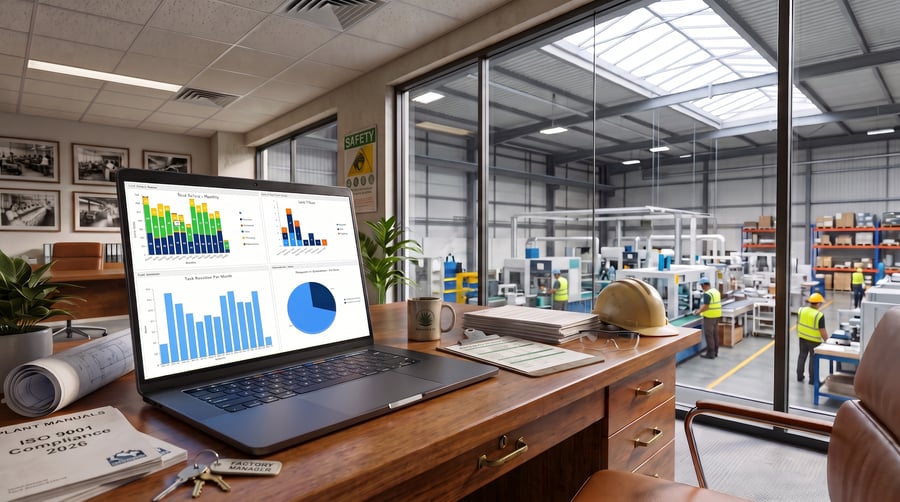
Step 5: Track Core PM Metrics (MTBF, MTTR, PM Compliance)
A framework cannot scale if it cannot be measured. A robust CMMS will automatically track the three definitive KPIs of preventive maintenance:
- Mean Time Between Failures (MTBF): Calculates reliability. (Formula: Total Uptime / Number of Failures). An increasing MTBF indicates successful PM scaling.
- Mean Time To Repair (MTTR): Calculates repair efficiency. (Formula: Total Downtime / Number of Repairs). A decreasing MTTR indicates technicians have the right checklists and parts on hand.
- PM Compliance Rate: The percentage of scheduled preventive maintenance tasks completed on time. World-class manufacturing facilities aim for a PM Compliance Rate of 90% or higher.
Enterprise vs. Agile CMMS: Choosing the Right Software
| Feature / Consideration | Maintenance Care | MaintainX | UpKeep | Limble |
|---|---|---|---|---|
| Target Focus | Purpose-built for mid-sized manufacturing facilities seeking agile, scalable PM automation. | Tailored for front-line teams prioritizing real-time chat and simple task tracking. | Engineered for large-scale enterprise environments with complex multi-site requirements. | Designed for asset-heavy operations needing deep technical custom dashboards and asset modeling. |
| Pricing Model | Unlimited Users (Flat Rate). Predictable budgeting designed to encourage plant-wide adoption. | Per-User Model. Tiered plans tailored for scaling smaller core teams seat-by-seat. | Per-User Model. Enterprise-level packages scaled to match dedicated software budgets. | Per-User Model. Tiered pricing with advanced features tied to higher subscription brackets. |
| Ease of Implementation | Agile Onboarding. Balanced setup built for industrial workflows and rapid technician adoption. | Lightweight Activation. Designed for quick, self-serve mobile setup with minimal initial configuration. | Comprehensive Rollout. Thorough, structured deployment tailored for dedicated IT departments. | Structured Setup. Detailed asset mapping required upfront to unlock full relational data features. |
| Preventive Maintenance | Industrial Automation. Direct support for time, usage, and condition-based triggers. | Standard Workflows. Focused on calendar schedules and digital task lists. | Advanced Tech Stack. Built for deep IoT sensor integration and extensive data modeling. | Asset-Centric PMs. Detailed tracking tied directly to complex equipment hierarchies. |
| System Flexibility | Agile Customization. Easily adapts checklists and workflows to shifting plant floor requirements. | Standardized Layouts. Maintains uniform procedures across basic operational workflows. | Highly Configurable. Deep structural customization engineered for dedicated software admins. | Rigid Hierarchy. Requires precise initial setup to maintain automated data linking across assets. |
| Key Operational Trade-off | Focused on core industrial CMMS execution rather than built-in real-time team chat apps. | Per-seat pricing can scale costs rapidly as shift workers and floor staff are added. | High feature complexity requires dedicated IT management and longer deployment cycles. | Strict data architecture requires significant upfront admin work before launching PMs. |
Frequently Asked Questions
What is the difference between reactive and preventive manufacturing maintenance?
Reactive maintenance (run-to-failure) fixes equipment only after it breaks down, leading to costly unplanned downtime. Preventive maintenance uses a scheduled framework based on time, usage, or condition triggers to service assets before failures occur, maximizing uptime and extending equipment lifecycles.
How do you measure the success of a preventive maintenance framework?
Success is measured using three core Key Performance Indicators (KPIs): Mean Time Between Failures (MTBF), Mean Time To Repair (MTTR), and Preventive Maintenance (PM) Compliance Rate. A scalable framework will consistently increase MTBF, decrease MTTR, and maintain a PM compliance rate above 90%.
Do mid-sized manufacturers need an enterprise CMMS for preventive maintenance?
No. While massive enterprise systems (like Fiix or Fluke) are built for complex, multi-national corporations, they often suffer from slow deployment and low user adoption. Mid-sized manufacturers benefit more from an agile CMMS, like Maintenance Care, which offers faster implementation, easier mobile dispatch, and immediate ROI.
How do I transition my maintenance team to a preventive strategy?
Start by ranking your machinery using an Asset Criticality Ranking (Class A, B, and C). Apply condition-based or usage-based triggers to your most critical assets first, build standardized checklists, and use an agile CMMS to automate work order dispatch.
Optimizing Your Maintenance Strategy
Scaling manufacturing preventive maintenance is a continuous feedback loop. By systematically ranking assets, establishing precise triggers, enforcing rigorous checklists, and automating dispatch through an agile CMMS like Maintenance Care, manufacturing facilities can drastically reduce unplanned downtime and maximize asset ROI.
Ready to automate your preventive maintenance framework?
Request a demo today and discover how Maintenance Care helps maintenance teams work smarter, not harder. Book your Demo today!



.svg)